
#123 The Light-Switch Child: Helping Little Musicians Focus (and Have FUN!)

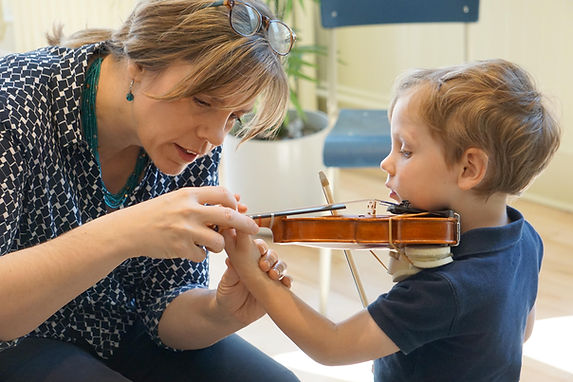
By Christy Hodder | Practicing Pro | www.ScotiaSuzuki.org
Does this sound familiar?
Your little one starts practising (or walks into their lesson) absolutely beaming. They play the first song. They play the second song. They're giggling, they're proud, they're SO into it.
And then... it's like someone flipped a light switch.
Suddenly they're lying on the floor. Or wandering off to look out the window. Or announcing, "I'm done. I want to go home." Five minutes ago they were having the time of their life, and now you can't get them to lift the violin one more time.
If you're nodding your head right now, I want you to know two things. First, you are NOT alone. I hear about this from parents and teachers all the time. And second, this is so, so fixable!
This is Part 1 of a three-part series on helping little musicians thrive: Attention, Enthusiasm, and Energy. Today, we're starting with attention!
Quick answer: To help a young child focus in music practice, keep each activity to 3–4 minutes, change it before their attention fades, use fewer words, turn repetition into a game, and always end on a win.
The Good News Hiding in Those First Five Minutes
I recently had a lovely phone call with a mom of a six-year-old violinist. She described her daughter exactly like this. Happy and excited for the first couple of things in her lesson, and then completely checked out. Getting her in the door was getting harder every week.
Here's what I told her, and what I want to tell YOU:
Those first five minutes are your proof.
If your child lights up at the start, then music brings them joy. That joy is real! The problem isn't that they don't love music. The problem is staying power.
And staying power is something you can build. Gently, playfully, one little step at a time.
Step One: Be a Detective
Every child has a hidden motivator. Your job (and your teacher's job) is to find it.
Think about it this way. You know you should clean the living room. It's been on your list all week. But the minute a friend calls and says, "I'm popping over in ten minutes!" — PRESTO! That room is spotless in five.
The task didn't change. The motivation did.
I once taught a student who practised every morning before school. And let me tell you, nothing in the world was going to stop that girl from doing her hair before she walked out the door! So she'd get up early, get started right away, and finish her practising in plenty of time to still do her hair. Every single day. Same student. Same music. Different motivator.
So put on your detective hat and get curious:
What does your child do at home, all on their own, without being asked?
What makes their eyes light up?
When do they try their very hardest?
That six-year-old I mentioned? Her mom told me she LOVES little rhythm cards, so much that she cuts up paper at home to make her own. She loves anything new. And she tries her absolute hardest when other children are around.
Those three little clues are pure gold. They tell us exactly how to build her lessons and her practising.
Why Little Ones Run Out of Steam
Young children are wired for short bursts. Their focus comes in little sprints, not marathons. That's not a flaw. It's just where they are right now!
A few things can drain that tank even faster:
Doing the same thing the same way. If they didn't get it the first time, hearing the exact same words again is when they switch off.
Too much talking. Long explanations lose little ears fast.
Timing. Asking a five-year-old to stand still and focus right after an hour of busy, active class is tough. Honestly, it would be tough for me too! Focus work first, movement after, almost always goes better.
Rewards bolted on at the end. A candy at the finish line might work once or twice, and then it fades. The fun needs to live inside the practice, not after it.
And here's one more thing I want you to hear: some children are "20-minute children" right now. That's okay! A shorter lesson or practice that ends on a high note beats a longer one that ends in tears. Every single time.

At Home: 7 Tips for Practising Parents
Practise in mini-chunks. Plan your practice in little 3–4 minute activities. Change what you're doing before the light switch flips, not after.
Never ask twice the same way. If it didn't land, switch it up! Show it instead of saying it. Turn it into a game. Be silly.
Use fewer words. One instruction at a time. Show more than you explain.
Make the finish line visible. Little ones relax when they can SEE the end. (The bead game below is perfect for this.)
Give them a job. Let your child choose the order of songs, run the timer, or make their own practice cards. Ownership is a powerful motivator.
Pick the right time of day. When is your child freshest? That might be before breakfast, before screens, or before a favourite activity. Bundle practice there.
Always end on a win. Stop while they're still smiling. You want them walking away thinking, "That was fun!"
One more thought.
That mom said something on our call that I loved: practising is a lot like reading. Your child won't always want to practise reading, but you build the habit anyway, because you know what it gives them. Music is exactly the same.
As Dr. Suzuki said, "Knowledge is not skill. Knowledge plus ten thousand times is skill." Those ten thousand times just need to be FUN ones!
In Lessons: Tips for Teachers
Teachers, this one's for you! Everything above applies in the lesson room too, plus a few extras:
Plan the lesson in activity blocks, not one long stretch. A 30-minute lesson might really be seven or eight mini-activities.
Speak to the age in front of you. It's easy to talk to a five-year-old like a ten-year-old. Shorter sentences. More showing.
Hide the technique inside the game. Your little one doesn't care about bow hold yet. But they DO care about winning the game, and the game can be all about bow hold!
Think about the order. If they have group class right before their private lesson, they may arrive with an empty tank. Lesson first, then group, often works better for little ones.
Consider a shorter lesson for a season. For some children, a joyful 20 minutes builds more than a frustrated 30.
Use the power of peers. Little ones try their hardest around other children. Preview the group class songs in the private lesson, so they walk into group feeling confident. Or end the lesson with a quick buddy song alongside the next student.
At Scotia Suzuki School of Music in Halifax, Nova Scotia, our teachers keep a shared cabinet of props, cards, beads and games for exactly these moments. When a little one starts to fade, a teacher can reach for something new and keep that spark alive. If you teach, I'd encourage you to build your own "spark box" too!

4 Play Games to Try This Week
These work at home AND in lessons. Pick one and give it a go!
1. Rhythm Card Builder. Let your child arrange rhythm cards in any order they like. You clap or play their pattern, then they clap or play it. Bonus: they can make brand new cards at home to bring to practice.
2. The Bead Counter. Line up five beads, or any objects, on one side of the music stand. Every time they repeat, they slide one bead across. When all five have moved, that job is DONE! They can see the finish line, so repetition never feels endless.
3. Fix the Grown-Up. You play with a big, silly mistake, like a wobbly bow or a flat wrist. Your child becomes the teacher and fixes you. (Little ones LOVE being the expert!)
4. Earn a Piece. For every task finished, your child earns a piece of something: a sticker on a scene, a puzzle piece, or a bit of clothing for a paper doll. By the end, they've built something wonderful.
GRAB THE FREE PRINTABLE
I've put all four play games and my four golden rules into one free printable. Print it double-sided, pop it on your music stand, and you'll always have an idea ready when the light switch starts to flicker.

